
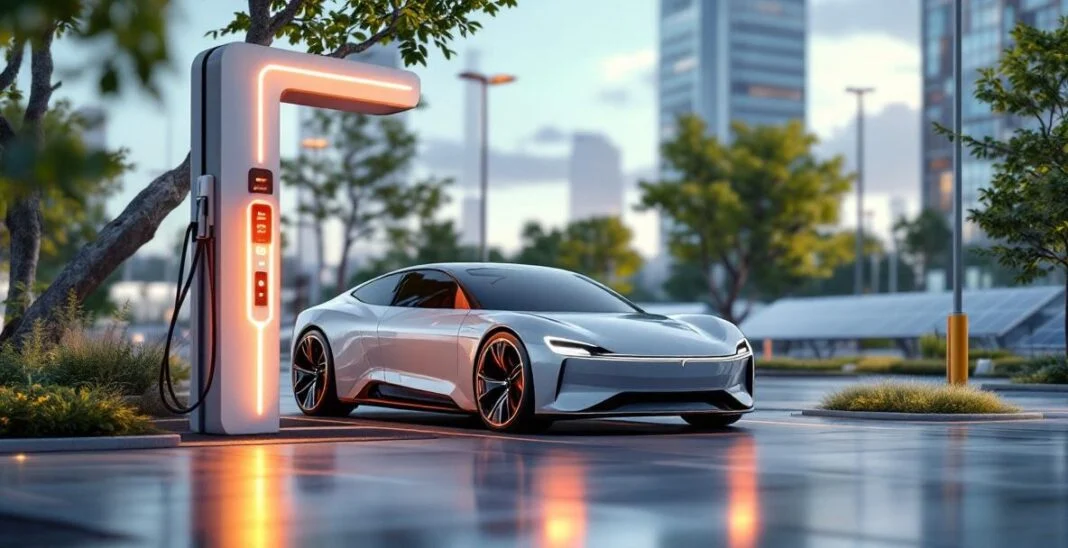
The Huawei solid-state EV battery could redefine the future of electric vehicles. The company has filed a new patent for a solid-state battery that claims a 3,000 km driving range and a full recharge in just five minutes. If it works outside the lab, it could be one of the biggest leaps in EV technology so far.
Unlike conventional lithium-ion batteries that use liquid or gel electrolytes, this solid-state version uses a nitrogen-doped sulfide solid electrolyte. This change boosts energy density, improves safety, and supports ultra-fast charging.
Huawei’s patent describes battery energy densities between 400 and 500 Wh/kg, up to three times higher than most current EV batteries. Under China’s CLTC test cycle, vehicles could reach 3,000 km on a single charge. Even with the more conservative U.S. EPA standards, the battery would still power an EV for over 2,000 km.
The Huawei solid-state EV battery also addresses one of the biggest EV pain points: charging time. According to the patent, it can recharge fully in five minutes—faster than filling a petrol tank. This would eliminate the “range anxiety” that discourages many drivers from switching to electric cars.
The nitrogen-doping process not only boosts energy storage but also enhances chemical stability. It reduces unwanted side reactions that typically lead to battery failure, overheating, or reduced life cycles. As a result, the battery becomes both safer and more durable.
Still, Huawei’s new tech faces real-world challenges. Although promising, many innovations fail to perform outside the lab. The company must overcome several hurdles before mass production becomes viable.
High production costs remain a major concern. Sulfide electrolytes are extremely expensive—reportedly as high as $1,400 per kWh, sometimes even costlier than gold by weight. These prices make it difficult to offer the battery in affordable EVs.
Scaling production from a patented prototype to full commercial output requires large investment and time. Manufacturers must solve problems related to packaging, reliability, and supply chain logistics.
There’s also the matter of battery size and weight. Achieving a 3,000 km range could require a pack that weighs over 1,000 kg, potentially affecting vehicle design, handling, and space efficiency.
Moreover, charging infrastructure will need upgrades. Today’s EV charging networks are not built for 5-minute full charges. Power grids and charging stations will require massive investment to support such high-capacity energy transfers safely.
Despite these obstacles, the Huawei solid-state EV battery patent represents a bold leap in a rapidly evolving market. Global players like CATL, Panasonic, Toyota, and QuantumScape are also racing to develop solid-state batteries. These firms aim to bring safer, longer-lasting, and faster-charging batteries to market.
According to industry forecasts, the global solid-state battery market will grow from $1.2 billion in 2024 to over $8 billion by 2030, with a compound annual growth rate above 56%.
Recent trends show strong momentum:
- Global EV sales grew by 25% in 2024, reaching 17 million units.
- Battery demand passed 1 terawatt-hour for the first time.
- Battery prices fell below $100 per kWh, nearing parity with combustion-engine vehicles.
- Government policies increasingly support zero-emission vehicles through incentives and mandates.
Nevertheless, critical barriers persist. These include:
- Securing mineral supply chains, especially for lithium, cobalt, and nickel.
- Expanding charging networks to keep pace with ultra-fast and high-capacity batteries.
- Balancing cost and performance, especially for mid-range and budget EV segments.
The Huawei solid-state EV battery arrives at a time when demand for cleaner, more efficient, and longer-lasting energy storage is surging. If Huawei can scale the technology while lowering costs, it could challenge global battery leaders and elevate China’s dominance in EV tech.
Beyond range and speed, this battery could reduce environmental impact. With fewer charges needed and a longer battery life, EV owners could spend less on energy and maintenance. Additionally, fast charging would ease the burden on public stations and reduce downtime.
The innovation is not without risk. Many solid-state designs look promising on paper but stumble during testing or fail under real driving conditions. Huawei must prove it can turn technical success into commercial reliability.
Nevertheless, the Huawei solid-state EV battery could become a turning point in electric mobility. With ultra-high energy density and five-minute charging, it has the potential to redefine how EVs are built, powered, and adopted.
In the next few years, the world will see whether Huawei’s battery can transition from patent to production—and whether it can become a real game-changer in the clean transport revolution.