

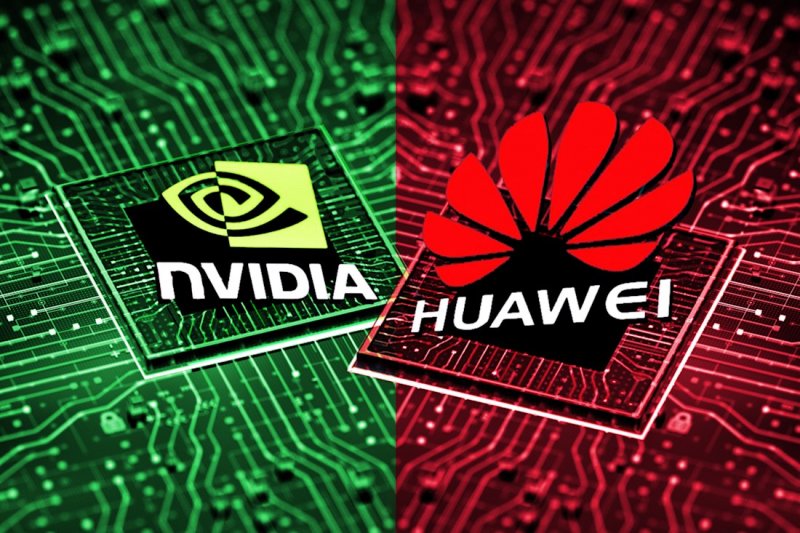
Huawei AI chips are at the heart of a bold three-year strategy aimed at narrowing the gap with Nvidia in the fast-growing AI market. The plan, unveiled at the annual Huawei Connect conference, highlights Huawei’s ambition to leverage its scale, government support, and networking expertise to challenge Nvidia’s dominance.
Eric Xu, Huawei’s rotating chairman, revealed the company’s vision before a global audience, presenting next-generation Ascend chips paired with upgraded “SuperPod” data center platforms. The move signals Huawei’s most aggressive push yet into artificial intelligence computing.
Huawei AI Chips and the SuperPod Vision
The strategy centers on connecting vast numbers of Huawei AI chips to create enormous clusters. Using its self-developed UnifiedBus interconnect protocol, Huawei claims it can link up to 15,488 Ascend processors. The system promises data transfer speeds up to 62 times faster than Nvidia’s upcoming NVLink144.
Huawei also announced plans to ramp up interconnect speeds to 4 terabits per second by 2028 with the Ascend 970. By comparison, Nvidia’s current maximum is 1.8 terabits per second. If delivered, this advance could reshape high-performance computing.
Performance and Market Context
Despite the ambitious roadmap, Huawei AI chips still lag behind Nvidia in raw performance. Analysts estimate that a single next-generation Ascend 950 delivers only about 6% of the performance of Nvidia’s upcoming VR200 superchip.
Huawei’s solution is scale. By clustering tens of thousands — even millions — of Ascend processors, the company believes it can bridge the performance gap through numbers and efficiency. This approach draws on Huawei’s long history in telecom equipment, where high-speed networking and interconnectivity are core strengths.
U.S. Pressure and China’s Response
The push into Huawei AI chips also reflects broader geopolitical pressures. U.S. restrictions have cut Huawei’s access to leading memory suppliers like SK Hynix and chipmakers like TSMC. Washington has moved to restrict Nvidia’s exports to China, fearing U.S. technology could strengthen China’s military and economic influence.
Beijing has responded with strong backing for domestic semiconductor firms. President Xi Jinping personally met with Huawei founder Ren Zhengfei earlier this year, underscoring the government’s commitment to supporting strategic industries. Senior officials have pledged national resources to accelerate breakthroughs in advanced chipmaking.
Innovation Amid Restrictions
Although U.S. sanctions blocked Huawei from advanced foundry access, the company has shown resilience. In 2023, Huawei shocked the industry by introducing a 7-nanometer chip for the Mate 60 Pro smartphone. While unable to move beyond that process, Huawei continues to innovate in architecture, memory access, and interconnect design.
At the Huawei Connect event, Xu emphasized the role of high-bandwidth memory and self-designed architectures in boosting processor performance. These innovations may not match Nvidia’s raw power per chip, but they showcase Huawei’s determination to compete through engineering ingenuity and large-scale integration.
The Race Ahead
Nvidia’s dominance remains formidable, with AMD and Intel struggling to keep pace. Companies like ASML and TSMC control key parts of the supply chain, leaving Chinese firms at a structural disadvantage. Still, Huawei’s plan for AI chips highlights how China’s largest tech players are pushing forward despite global restrictions.
The real test will come in execution: whether Huawei can deliver on its ambitious interconnect claims, manufacture at scale, and convince customers that its clusters can rival Nvidia’s platforms. With government support and relentless innovation, Huawei’s three-year plan could reshape the competitive landscape of the AI chip industry.