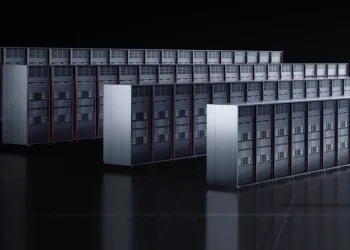


Nvidia has launched its next-generation AI supercomputing platform, directly challenging rivals like Huawei. The newly unveiled Nvidia Rubin SuperPOD, revealed at CES 2026, promises extreme performance density. This system integrates the company’s forthcoming Rubin GPUs and Vera CPUs into a cohesive rack-scale solution. According to specifications, a single DGX rack with 576 Rubin GPUs can deliver 28.8 Exaflops of FP4 performance. Consequently, this achievement significantly raises the bar for computational efficiency in large-scale AI training and inference. The Nvidia Rubin SuperPOD appears engineered to compete directly with Huawei’s Atlas 950 SuperPod in the high-stakes AI infrastructure market.
The system’s architecture centers on dense integration and high-speed interconnects. Each DGX rack houses multiple NVL72 or NVL8 systems, which function as a single coherent AI engine. An NVL72 module combines 36 Vera CPUs, 72 Rubin GPUs, and 18 BlueField-4 DPUs. This design delivers a reported 50 petaflops of FP4 performance per system. Furthermore, aggregate NVLink throughput reaches a staggering 260 terabytes per second per rack. This massive internal bandwidth allows the entire rack’s memory and compute resources to operate in unison. Therefore, the Nvidia Rubin SuperPOD minimizes latency and complexity for sprawling AI workloads.
Performance and Efficiency Advantages
The efficiency claims are a central part of Nvidia’s competitive narrative. A full Nvidia Rubin SuperPOD configuration achieves 28.8 Exaflops using only 576 GPUs. In contrast, Huawei’s Atlas 950 SuperPod claims approximately 16 Exaflops of FP4 performance per pod. This comparison suggests Nvidia’s solution offers greater performance per GPU. Moreover, Nvidia’s design requires fewer physical nodes and cabinets than Huawei’s SuperCluster architecture. Huawei’s approach often scales using thousands of NPUs and petabytes of memory. Conversely, Nvidia emphasizes performance density, which potentially reduces space, power, and cooling overhead for customers. This efficiency could translate into lower operational costs for massive AI factories.
The Rubin GPU itself incorporates several key advancements. It features a third-generation Transformer Engine and hardware-accelerated compression. These technologies allow inference and training workloads to process far more efficiently at scale. The platform also unifies AI compute, networking, and software into a single optimized stack. Each DGX rack includes 600 terabytes of fast memory alongside high-performance NVMe storage. Integrated AI context memory specifically supports both training and extended inference pipelines. This holistic design is a hallmark of the Nvidia Rubin SuperPOD philosophy, prioritizing end-to-end performance over discrete component speed.
Integrated Networking and Software Stack
Networking is a critical component of the system’s design. The platform leverages Spectrum-X Ethernet for efficient east-west AI traffic management. Simultaneously, Quantum-X800 InfiniBand provides the low-latency, high-throughput backbone. ConnectX-9 SuperNICs support deterministic high-speed AI data transfer. This comprehensive networking approach aims to eliminate bottlenecks in large clusters. The software layer receives equal emphasis through Nvidia AI Enterprise and NIM microservices. Mission Control software provides orchestration, automated recovery, and infrastructure management. Consequently, the Nvidia Rubin SuperPOD offers a fully integrated environment for deploying agentic AI and multimodal models.
The strategic context of this launch is clear. Nvidia is defending its AI infrastructure leadership against strong challengers, primarily Huawei. While Huawei scales capability primarily through hardware volume, Nvidia’s response focuses on architectural integration and efficiency. The company argues that its tightly coupled software and hardware control reduces operational complexity. This debate will ultimately be settled in the data centers of major cloud providers and research institutions. The Nvidia Rubin SuperPOD represents a calculated bid to maintain technological and market superiority. Its success depends on delivering real-world performance that matches its impressive specifications.
Market Implications and Competitive Landscape
This announcement intensifies the global race for AI compute supremacy. The Nvidia Rubin SuperPOD directly targets the same hyperscale and government clients as Huawei’s systems. Performance density is becoming a key differentiator as electricity costs and physical space constraints grow. Nvidia’s claim of superior efficiency per GPU could influence major purchasing decisions. However, geopolitical factors and supply chain considerations will also play a significant role. The platform’s reliance on advanced packaging and memory technologies presents its own set of challenges. Nonetheless, the unveiling sets a new benchmark for what constitutes a state-of-the-art AI supercomputing cluster.
The broader impact on AI development could be substantial. Access to such concentrated compute power may accelerate breakthroughs in large language model training and scientific simulation. The Nvidia Rubin SuperPOD architecture is designed for the next generation of long-context reasoning and generative AI tasks. Its release signals Nvidia’s confidence in the continued exponential growth of AI computational demands. The coming months will see rigorous independent testing of these performance claims. The entire industry will watch closely to see if the real-world performance of the Nvidia Rubin SuperPOD justifies its ambitious specifications.