

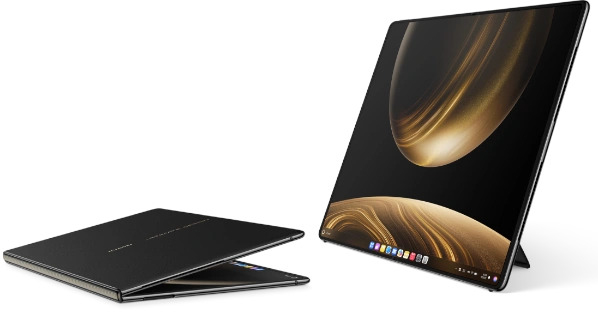
Huawei’s latest innovation, the Huawei MateBook Fold, was expected to debut with a cutting-edge chip, but instead features an older 7nm processor, highlighting the continuing impact of U.S. technology export restrictions on China’s semiconductor ambitions.
According to Canadian research firm TechInsights, the laptop is powered by the Kirin X90, built on SMIC’s 7nm N+2 process node, the same technology used in Huawei chips since 2023. This chip is a generation behind the anticipated 5nm equivalent N+3 node, signaling that SMIC — China’s top chipmaker — has not yet achieved mass production at 5nm scale.
U.S. Curbs Slow China’s Chip Race
The Huawei MateBook Fold chip development illustrates the broader challenges facing China’s chip industry. SMIC’s progress has been stalled due to U.S. restrictions on advanced chipmaking tools, especially extreme ultraviolet (EUV) lithography. These sanctions have forced Chinese foundries to use less efficient multi-patterning techniques, which significantly reduce chip yield and scalability.
“U.S.-imposed technology controls are likely continuing to impact SMIC’s ability to catch up to current foundry leaders,” TechInsights stated, noting that China remains at least three generations behind global leaders like TSMC and Intel, who are preparing for 2nm chip production by 2026.
Huawei’s Self-Reliant Strategy
The MateBook Fold marks a key step in Huawei’s push for a fully self-reliant tech ecosystem. With an 18-inch OLED double screen and no physical keyboard, the device is one of two laptops recently launched under Huawei’s HarmonyOS platform. These are the first laptops to ship without Intel or Qualcomm processors after the U.S. revoked export licenses to Huawei last year.
This move is part of Huawei’s larger effort to reduce dependence on Western technology and build a vertically integrated stack encompassing hardware, chip design, and operating systems. Still, the lack of next-generation silicon underlines how difficult it remains to completely untether from global supply chains.
Chip Lag vs. Global Competitors
While Huawei and SMIC have made progress under tight sanctions, their chips still lag behind international standards. The Kirin X90 is far less advanced than chips from Apple, Qualcomm, or AMD, whose processors now operate at 4nm and below.
Huawei’s CEO Ren Zhengfei recently told Chinese state media that the company’s chips are just “one generation behind” U.S. rivals, citing performance optimization through cluster computing as a stopgap measure. However, independent analysis like TechInsights’ casts doubt on whether these solutions can compensate for the manufacturing gap.
What It Means for Global Tech
This development reveals the limits of China’s decoupling strategy in semiconductors. As Huawei MateBook Fold chip production sticks to 7nm, it suggests that even top-tier Chinese tech firms are constrained by geopolitical forces.
The world’s attention now turns to how quickly China can close the gap and whether domestic innovation or international partnerships can overcome the U.S.-led blockade on high-end chip technologies.